
Keeping your swimming pool safe, clean, and inviting isn’t just about skimming leaves or running the pump. The real key is regular pool water testing. Without it, your water can turn cloudy, your surfaces can stain, and your swimmers may experience irritation. Many homeowners are unsure about how often to test or which factors to focus on, so let’s break it down step by step in a clear way.
Miller Outdoors specializes in pool design and construction as well as ongoing maintenance, and we’ve seen first-hand how proper testing saves time, money, and frustration. Done right, testing gives you the confidence that your pool is safe to enjoy.
Why Is Pool Water Testing So Important?
Pool water looks harmless when it’s clear, but there’s a lot happening on a chemical level. Without regular testing, bacteria can grow, minerals can damage your equipment, and the water balance can swing wildly. Here’s why it matters:
- Health and safety: Balanced water prevents harmful bacteria, algae, and germs from spreading. It also keeps your eyes, skin, and hair from becoming irritated.
- Protecting pool surfaces and equipment: Unchecked chemistry can cause corrosion of metal parts, scaling on tile, or damage to pumps and filters.
- Saving money in the long run: By catching small problems early with pool water testing, you reduce the need for costly chemical treatments or repairs later on.
How Often Should Pool Water Testing Be Done?
This is the big question every pool owner asks. The truth is, not all tests need to be done every single day, but you can follow this routine for safe results:
- Two to three times a week: Test chlorine and pH levels. These two readings affect everything else, from swimmer comfort to water clarity.
- Once a week: Check alkalinity, calcium hardness, and stabilizer (cyanuric acid). These readings help you understand the overall balance and prevent damage.
- Once a month: Run a more detailed check that includes metals like copper and iron. While less common, these can cause staining or discoloration.
By sticking to this simple schedule, you’ll avoid the guesswork and keep your pool healthy year-round. An electronic pool water tester can make the process faster and more accurate than relying on strips alone.
Which Pool Water Parameters Should You Check?
When balancing pool chemicals, you’re really focusing on a handful of key measurements. Each plays a role in keeping everything stable.
- Chlorine: This disinfectant kills bacteria and keeps the water sanitary. Too little and germs thrive, too much and swimmers feel uncomfortable.
- pH level: This measures how acidic or basic the water is. The sweet spot is between 7.2 and 7.6. If it drifts out of range, chlorine becomes less effective, and swimmers may feel irritation.
- Total Alkalinity: This acts like a cushion for pH. If alkalinity is too low, pH will swing up and down constantly. If it’s too high, the water becomes cloudy and scaling may appear.
- Calcium Hardness: Water that’s too soft eats away at plaster and metal. Water that’s too hard leaves deposits on tile and equipment.
- Stabilizer (Cyanuric Acid): Outdoor pools lose chlorine quickly in sunlight. This chemical acts like sunscreen for your chlorine, keeping it effective longer.
- Metals: While not always present, metals like copper or iron can cause stains or turn water a strange color. Monthly checks help prevent surprises.
Tools for Pool Water Testing
You can test your pool in a few different ways, but some methods are easier than others.
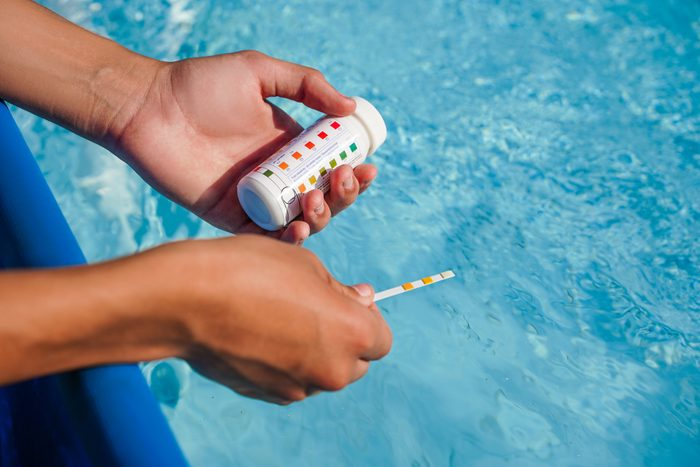
- Test strips: These are affordable and quick. Dip them in the water, match the colors, and you’ll get a rough idea of your levels. They’re helpful for a fast check but can sometimes be inaccurate.
- Liquid test kits: These involve adding drops of solution to a water sample. They’re more accurate than strips but take a little longer and require careful measuring.
- Electronic pool water testers: These devices give fast and precise digital readings. They reduce human error and are worth considering if you want reliable results without second-guessing.
Many of our clients prefer electronic testers because they simplify the process. Even so, professional services like ours offer the most complete testing, since we pair the results with expert treatment and balancing pool chemicals immediately.
How Professional Pool Services Can Help
Testing is one thing. Acting on the results is another. That’s where Miller Outdoors steps in. Our team doesn’t just run the numbers; we balance the water on the spot, handle hard-to-correct issues, and spot early warning signs you might miss.
We also tie water care into the bigger picture. If you’ve trusted us with your pool design and construction, or your outdoor living spaces, you know that every detail matters. Regular pool water testing protects that investment and helps your outdoor area look and feel its best.
For those planning larger updates, our landscape design and installation services can create a cohesive space around your pool. And if you’re budgeting improvements, our landscape design cost calculator is a helpful planning tool.
Contact Miller Outdoors for Pool Installation and Services
Consistent pool water testing is the foundation of a clean, safe, and beautiful pool. By knowing how often to test and which parameters to check, you protect your family’s health, avoid costly repairs, and keep your pool looking crystal clear. While home kits and electronic testers can help, nothing beats the convenience of a professional service that handles both the testing and the balancing for you.
Miller Outdoors is here to help you with every step of pool care—from designing your dream pool to keeping it safe through ongoing maintenance. If you’re ready to simplify your pool ownership, schedule your discovery call or give us a call at (504) 452-3131.
With the right care and regular testing, your pool will always be ready when you are.
FAQs About Pool Water Testing
1. Can I rely only on test strips for my pool?
Test strips are fine for quick checks, but they shouldn’t be your only method. For more accuracy, it’s best to use a liquid kit or an electronic pool water tester, or let a professional service handle it.
2. Why does my pool water turn cloudy even when chlorine looks fine?
Cloudiness often comes from pH or alkalinity being off, or from calcium hardness problems. Balanced chemistry is about more than just chlorine.
3. How can I prevent algae from coming back so quickly?
Regular brushing, circulation, and pool water testing all help. If chlorine and pH aren’t in range, algae can bloom fast, even in clean-looking water.
4. Is there a safe source to learn more about pool water safety?
Yes, the Centers for Disease Control and Prevention (CDC) provides guidelines on pool disinfection and testing that reinforce the importance of regular checks.